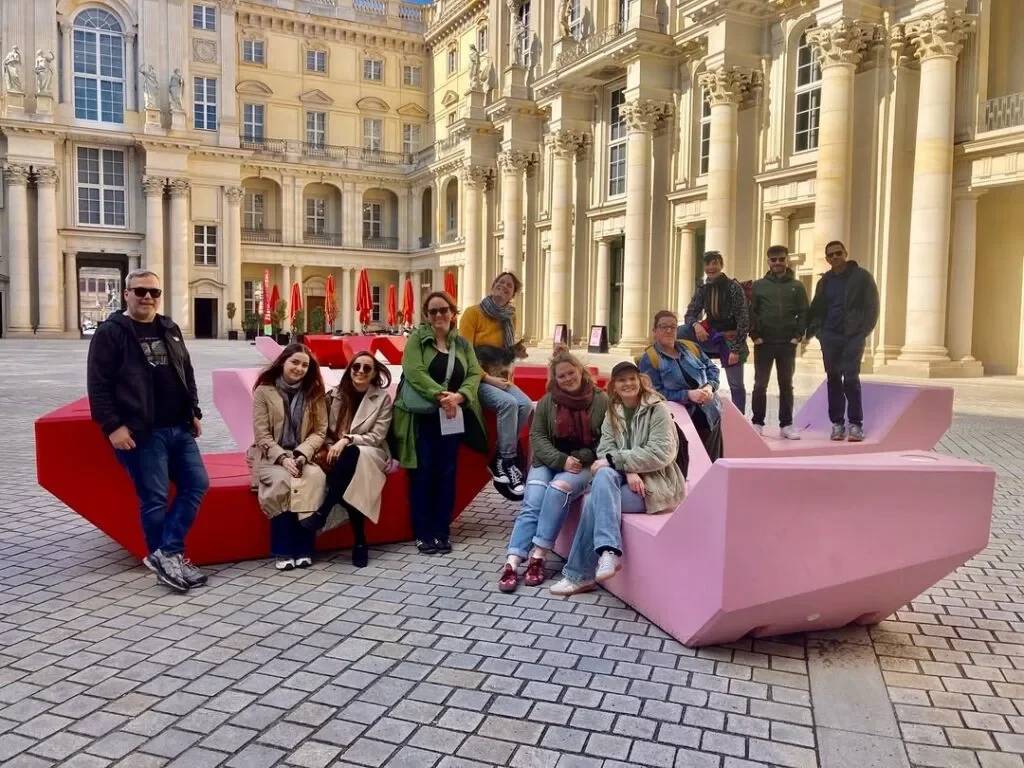
Some partnerships are built around funding. Others are built around ideas, people, and the gradual work of changing how a space functions and feels. Our partnership with Deutsche Schreberjugend belongs firmly to the second category, and it has become one of the collaborations we value most. Schreberjugend is a German youth organisation with a long tradition in community gardening, sustainability education, and international youth work. Through exchanges and collaborative programmes, it works with partners across Europe and beyond, including Albania. Its work brings together urban sustainability, civic education, youth empowerment, and community-led environmental action — areas that connect naturally with the way N’Zon thinks about coworking and community. N’Zon itself draws inspiration from Bauhaus principles, where design is not only about aesthetics but also about how everyday environments can serve people better. Schreberjugend approaches a similar question through another lens: how green spaces, biodiversity, education, and community participation can improve the places where people live and work. From the first conversations, the partnership felt natural. The first major chapter began in October 2025, when our team travelled to Berlin for a four-day Professionals’ Exchange (ProfXChange) hosted by Schreberjugend. The programme combined meetings, garden visits, workshops, discussions, and shared meals, creating space not only to exchange knowledge but also to build genuine working relationships. At the Schreberjugend headquarters in Hermannstraße, we were welcomed with a tour of the building and the exhibition “Small Gardens, Large Impact,” which introduced many of the themes that would shape the following days. We visited Schreberjugend’s gardens and learned more about their school garden initiatives and the Mitmachgarten, or participatory garden, model in practice. The exchange also brought us together with partners from Northern Ireland, who shared their own experiences with community-based work. Our programme continued across Berlin with visits to places that demonstrate different approaches to urban green space. We explored Tempelhofer Feld, the former airport that has become one of Berlin’s most distinctive public open spaces, and visited Prinzessinnengarten, an urban gardening initiative where community participation is integrated into everything from planting to events and educational activities. The practical workshops were among the most valuable parts of the exchange. During a Saturday session, we built a raised garden bed and learned about seed extraction and preservation. We also took part in a workshop on biochar, exploring its use both as a soil improver and as a practical climate-related measure. Later, we joined a Familiennacht community event where neighbours harvested, cooked, and ate together. Not everything we experienced in Berlin can simply be copied and transferred to Tirana. But many of the principles behind these activities can. Community participation, shared responsibility, practical environmental education, and the idea that green spaces can bring people together are all concepts that can be adapted to the N’Zon context. The closing session at Futurium, appropriately titled “Let’s Act,” marked an important shift in the exchange. By that point, the trip was no longer simply about observing projects in Berlin. It had become a conversation about what we could build next. We returned with concrete ideas about how to integrate green practices more deeply into N’Zon, further develop our community garden concept, and explore how a small, sustainability-oriented coworking space can create an impact beyond its own physical walls. Those conversations also opened possibilities for initiatives beyond Tirana, including potential activities in rural areas of Albania. What makes the partnership with Schreberjugend particularly valuable is that it has never felt like a one-directional exchange. It has not been approached as a larger, more established organisation simply transferring knowledge to a younger one. Instead, the relationship has been built around cooperation, shared development, and an understanding that both sides bring different experiences and perspectives to the table. That is what turns an exchange programme into a real partnership. Our thanks go to Deutsche Schreberjugend and to everyone who helped make this collaboration tangible — through the gardens we explored, the workshops we shared, the conversations we continued, and the time spent together in Berlin.
Blog
Schreberjugend: Four Days in Berlin
How a four-day professional exchange in Berlin with Deutsche Schreberjugend became the starting point for a long-term partnership around sustainability, community, and green spaces.