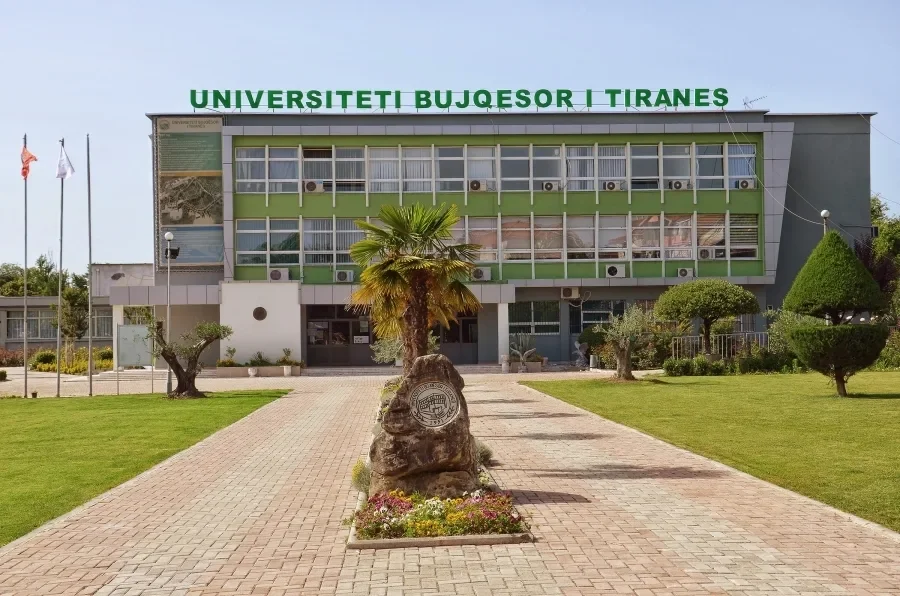
Some partnerships do not fit neatly into the categories of funder, client, or supplier. Their value comes instead from shared knowledge, long-term collaboration, and the opportunity to build something meaningful together. For N’Zon, the Agricultural University of Tirana (UBT) has become exactly that kind of partner. Founded in 1951, UBT is one of Albania’s leading public universities in fields including agronomy, environmental sciences, forestry, horticulture, biotechnology, and related disciplines. For N’Zon, a space that places importance on sustainability, green practices, and thoughtful design, the university represents a natural institutional partner. The relationship between N’Zon and UBT has now been formalised through a Memorandum of Understanding (MoU). The agreement creates a framework for cooperation in areas of shared interest, including green practices, sustainable urban design, biodiversity, and the integration of academic research into real-world environments. For a young coworking space like N’Zon, this collaboration is also an important confirmation that our approach to sustainability is being recognised beyond our own community. On 29 October 2025, the partnership moved from an agreement on paper into a practical collaboration inside the space. Students from the Department of Horticulture and Landscape Architecture, as part of their Landscape Design Studio II course, visited N’Zon to present their site analysis. It was the department’s first student visit to our space and the first concrete activity developed within the framework of the Memorandum of Understanding. The visit created value on both sides. For the students, it offered the opportunity to apply their landscape architecture knowledge to an active space with real users, practical limitations, and a design brief shaped by an existing environment rather than a theoretical case study. For us, it was an opportunity to see N’Zon from a completely different perspective. Students and professors approached the space through elements such as circulation, microclimate, planting strategies, and the relationship between built and open areas. Site analysis is often considered simply the first stage of a design process. In this case, however, the analysis itself became valuable. It helped us identify and better understand aspects of the space that we had not previously articulated in the same way. The educational side of the collaboration is just as important as the design component. Students were able to work on a real site and present their observations and ideas inside the environment they were studying. This type of applied learning reflects an approach that N’Zon strongly values: bringing theory and practice closer together and allowing the physical environment itself to become part of the learning process. The Memorandum of Understanding gives us the framework for future collaboration, while the first studio visit has given us a clear starting point. The conversations with UBT are now focused on how this relationship can develop over time through additional studio projects, research initiatives, student internships, and the possibility of using N’Zon as an applied site for university work related to sustainable urban environments. The first chapter of the collaboration has already been written. The next ones are beginning to take shape. Our thanks go to the Department of Horticulture and Landscape Architecture at the Agricultural University of Tirana, the professors leading the Landscape Design Studio II course, and the students who visited N’Zon on 29 October 2025 and contributed a new perspective to our space.
Blog
Agricultural University of Tirana: Where the Gardens Meet the Studio
How N’Zon’s Memorandum of Understanding with the Agricultural University of Tirana is creating new opportunities for applied learning, sustainable design, and collaboration.